


Gombe Stream National Park

Overview
An island on the shore of the lake
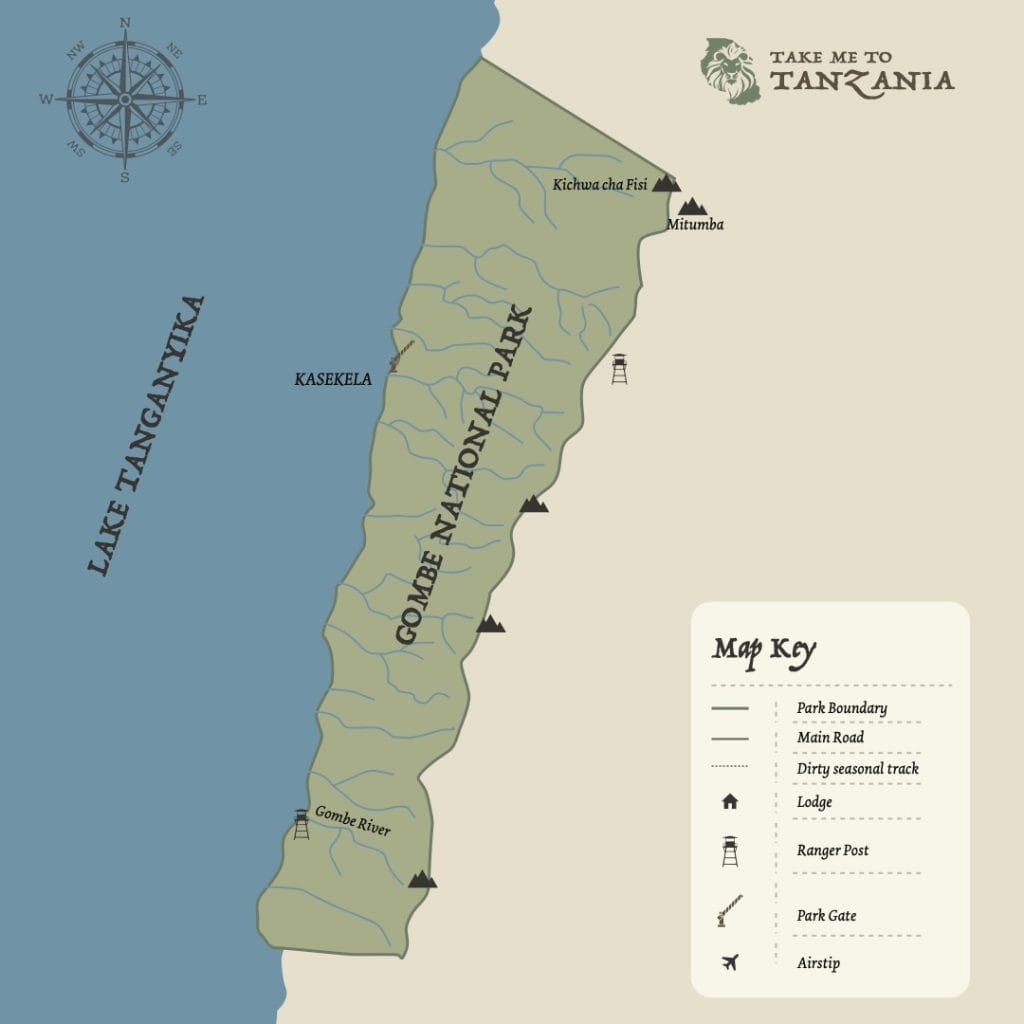
Gombe Stream National Park is situated in the western border of Tanzania, and is easily accessible by boat from Kigoma town which is 16 km to the south. With an area of only 52 sq km, Gombe Stream is one of the smallest National Parks in Tanzania, comprising a narrow strip of mountainous country bounded in the east by the crest of the Great Rift Valley escarpment, and in the west by Lake Tanganyika, the world’s longest and second deepest at 1400 meters deep.Gombe Stream, like its sister game park of Mahale Mountains to the south, is a park without roads, where you can experience nature on foot accompanied by the park guide. The park's vegetation varies from the evergreen forests of tall trees to open woodlands and grasslands. The park's most special feature is its chimpanzees, made famous by Jane Goodall's study.
Wildlife
Chimpanzees are classed as one of the worlds’ endangered species, and are the primary visitor attraction in Gombe. Other common mammals found are forest species, mostly primates including baboons, blue monkeys, vervet monkeys, red tailed monkeys and red colobus monkeys. There are more 200 species of birds in Gombe Stream National Park.
When to Visit
Two well-defined seasons (except in the evergreen forests): a dry season from mid-May to October/November and a wet season from November to mid-May (less rainy in January and February). Bush fires occur on the crests of the hill during the dry season. Negligible seasonal variation in the occurrence of animals, but the best time for plants and insects is during the wet season
Excursion and Activities in Gombe National Park
Gombe National Park, famous for its connection to Jane Goodall’s chimpanzee research, offers a unique and intimate wildlife experience. Here are the main activities and excursions visitors can enjoy:
- Guided chimpanzee Trekking tours into the forest:- The main attraction! Hike through the forest with a guide to observe wild chimpanzees in their natural habitat. Best done in the morning when the chimps are most active.
- Hiking & Nature Walks:- Explore the scenic trails through lush forests, waterfalls, and hills. The hike to Jane’s Peak offers stunning views of the park and Lake Tanganyika.
- Bird Watching:- Home to over 200 bird species, including fish eagles, palm-nut vultures, and the rare Peter’s twins pot. Great for bird lovers and photographers.
- Boat Safaris on Lake Tanganyika:- Enjoy a boat ride on Africa’s second deepest lake, with opportunities to spot hippos, crocodiles, and a variety of fish. Perfect for relaxation after trekking.
- Snorkelling & Swimming in Lake Tanganyika:- The crystal-clear waters of the lake offer a refreshing swim. Snorkelling reveals colourful fish species unique to the lake.
- Visiting Jane Goodall’s Research Center:- Learn about the groundbreaking chimpanzee research that started in the 1960s. Gain insights into conservation efforts and ongoing studies.
Getting there
A remote park,
Arrival by boat
Alternatives for the boat trip from Kigoma (a town on the shore of Lake Tanganyika 16 km south of Gombe) to Kasekela (arrival point in the park; 24 km from Kigoma) are: 1) daily water-taxi (except Sun): departure in the afternoon, return in the morning (2-4 hrs one way), 2) a boat direct to Gombe (can be ordered by a radio call from the TANAPA office in Kigoma, 2 hrs/one way)
Journey to Kigoma by train, air or road: there are regular rail services and flights from Dar es Salaam to Kigoma, and private flights are organized by the safari companies as well. Driving by car from Dar es Salaam to Kigoma (1760 km) takes 4 days, the first 98o km on a good tarmac road to Tunduma (on the Zambian border), and the last 780 km to Kigoma on a dirt road (difficult or impassable in the wet season)
OTHER DESTINATIONS
Serengeti National Park
Learn MorePrison Island
Learn MoreNgorongoro Conservation Area Authority
Learn MoreStone Town
Learn MoreMikumi National Park
Learn MoreChumbe Island Coral Park
Learn MoreMnemba Island
Learn MoreArusha City
Learn MoreDar es Salaam City
Learn MoreMount Longido
Learn More
