


Kilimanjaro National Park

Overview
Africa’s Highest Peak, Nature’s Grandest Stage
Mount Kilimanjaro is Africa’s highest peak and the tallest free-standing volcano in the world, rising to 5,895 meters above sea level. Located in northern Tanzania, it’s home to three volcanic cones—Kibo (dormant), Mawenzi (dormant), and Shira (extinct). The park spans 1,712 km² and was declared a UNESCO World Heritage Site in 1987 and a Natural Wonder of Africa in 2013.
The name “Kilimanjaro” is believed to come from the Swahili word Kilima (mountain) and the Chagga word Njaro (whiteness), meaning “White Mountain.” Its snow-capped peak is a global icon and a bucket-list destination for adventurers.
Wildlife
Mount Kilimanjaro National Park is rich in biodiversity, home to 140 mammal species including:
- Elephants, elands, buffaloes, and primates like blue monkeys and black-and-white colobus monkeys.
- A variety of antelopes and seven species of primates.
- Over 179 bird species, especially in the montane forest belt.
- The park also supports rare high-altitude animals and migratory species along the Shira Plateau
When to Visit
There are two distinct seasons:
- Dry season (June – September): Best for climbing with clear skies and cooler nights.
- Wet season (March – May): Heavy rain at lower elevations, snow accumulation at the summit. Rainfall varies by zone—from 828 mm in alpine desert to 2,500 mm in montane forest. The park altitude ranges from 1,700 to 5,895 meters, offering a wide range of climates and ecosystems.
Excursion and Activities in Kilimanjaro National Park
Kilimanjaro offers more than just mountain climbing. Explore diverse adventures for all types of visitors:
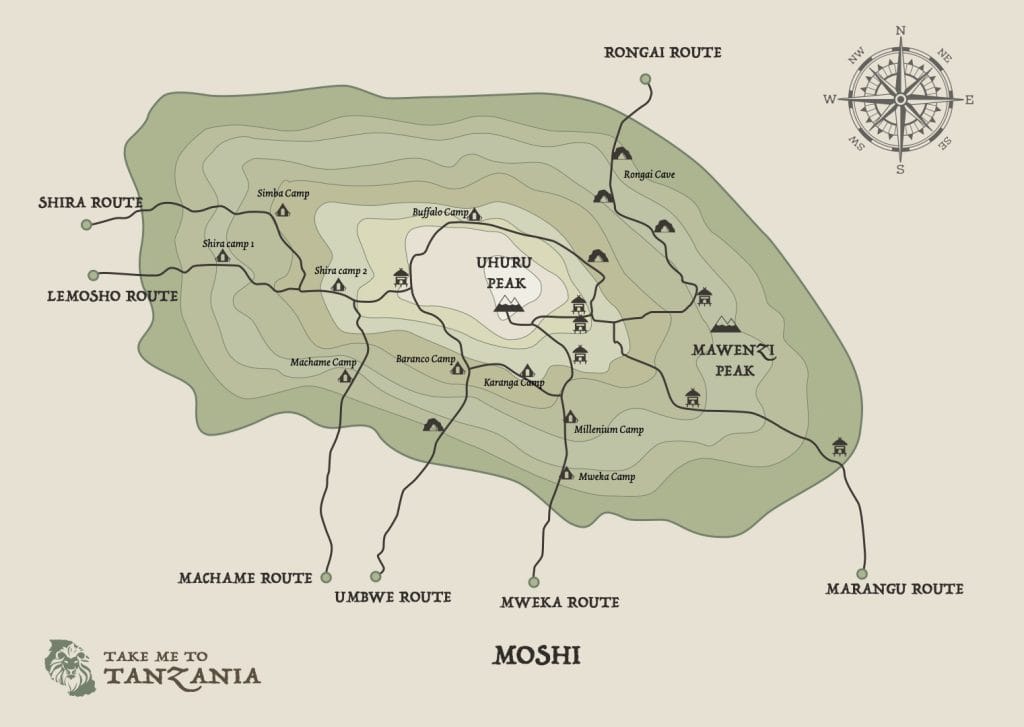
- Mountain Climbing:- Summit climbs take 5 to 8 days, depending on the route, Popular routes include Marangu, Machame, Lemosho, Rongai, Umbwe, and Londorosi. Longer routes increase your chance of reaching the summit.
- Mountain Cycling:- Two official cycling routes: Kilema for summit-bound climbers and Shira Plateau for scenic rides.
- Equipped with picnic areas and rest points.
- Mawenzi Technical Climbing:- Technical climbers can challenge Mawenzi Peak (5,149m) with its dramatic ridges, gullies, and cliffs.
- Paragliding:- A rare adventure: paraglide from the top of Kilimanjaro for a once-in-a-lifetime thrill.
- Nature Walks & Non-Summit Activities:- Short and long walking safaris through the montane forest.
- Visit Lauwo Waterfall, Maundi Crater, Shira Plateau, and Kifinika Cultural Site.
- Watch wildlife and high-altitude bird species without needing to summit.
- Filming & Photography:- Kilimanjaro’s landscape has featured in award-winning films like The Snows of Kilimanjaro (1952), based on Ernest Hemingway’s story.
Attractions & Unique Features
Three Peak
- Kibo (5,895m): Highest point and permanent snow cap.
- Mawenzi (5,149m): Rugged and glacier-scarred.
- Shira (3,962m): Now a plateau teeming with wildlife.
- Encircles the mountain between 1,800–2,800 meters.
- Home to endemic plants like Impatiens kilimanjari.
- Ideal for Marangu nature walks and cultural forest experiences.
- Zonation of Vegetation
The park features five eco-climatic zones that simulate a trip from the equator to the arctic:
- Montane Forest
- Heath & Moorland
- Alpine Desert
- Summit (Arctic Zone)
- Snow is present at the summit year-round, a rarity so close to the equator.
Lauwo Waterfall & Maundi Crater
- Lauwo Waterfall: Just 2.8 km from Marangu route, deep in forest.
- Maundi Crater: A short hike with panoramic views of lakes Chala, Jipe, and Nyumba ya Mungu.
- Cultural Heritage:- Kifinika Site: A sacred Chagga site used for traditional rituals. Nearby villages offer cultural tourism programs, including craft workshops and traditional cuisine.
Getting there
Mount Kilimanjaro is easily accessible by road and air:
By Air
- Fly into Kilimanjaro International Airport (JRO), about 45 km from the park.
- Most climbers begin their journey from Moshi Town, located 41 km from Marangu Gate.
By Road
- 123 km (approx. 2 hours) from Arusha via tarmac road.
- The park has multiple entry points: Marangu, Machame, Rongai, Umbwe, Mweka, Londorosi, Lemosho, and Kilema gates.
OTHER DESTINATIONS
Serengeti National Park
Learn MorePrison Island
Learn MoreNgorongoro Conservation Area Authority
Learn MoreStone Town
Learn MoreMikumi National Park
Learn MoreChumbe Island Coral Park
Learn MoreMnemba Island
Learn MoreArusha City
Learn MoreDar es Salaam City
Learn MoreMount Longido
Learn More
