


Nyerere National Park (Selous Ecosystem)

Overview
An untamed and superabundant wilderness
Nyerere National Park, once part of the vast Selous Game Reserve, is a place of rich history and breathtaking wilderness. It was first granted formal protection in 1896 during Tanzania’s time as a German colony, later named after famed explorer Frederick Selous in 1922, and designated a UNESCO World Heritage Site in 1982. In 2019, 30,000 square kilometers were reclassified as Nyerere National Park, honoring Tanzania’s first president, Julius Nyerere, a dedicated conservationist. As Africa’s second-largest national park, it offers diverse landscapes, from the meandering Rufiji River and its oxbow lakes to vast savannahs and baobab-studded woodlands teeming with wildlife. Unlike many East African parks, its network of small game-viewing tracks allows for close yet respectful encounters with elephants, lions, giraffes, and even rare wild dogs, making it an unmissable safari destination year-round.
Wildlife
Nyerere National Park, formerly part of the renowned Selous Game Reserve, is one of Africa’s largest and most untouched wilderness areas, spanning over 30,000 square kilometers. Home to an incredible variety of wildlife—including elephants, lions, leopards, African wild dogs, kudu, sable, and hippos—it offers a diverse safari experience across savannahs, wetlands, and the meandering Rufiji River.
When to Visit
Two well-defined seasons: a dry season from June to October and a wet season from November to May (less rainy in Jan-Feb). Bushfires occur annually in the dry season. The seasonal variation in the occurrence of animals is negligible, although the wildlife populations have their own seasonal movements within the ecosystem
The best time to visit is June-October, The park's roads are passable in the dry season but difficult during the wet season. The park is virtually inaccessible during the heavy rains from mid-March to May
Excursion and Activities in Nyerere National Park
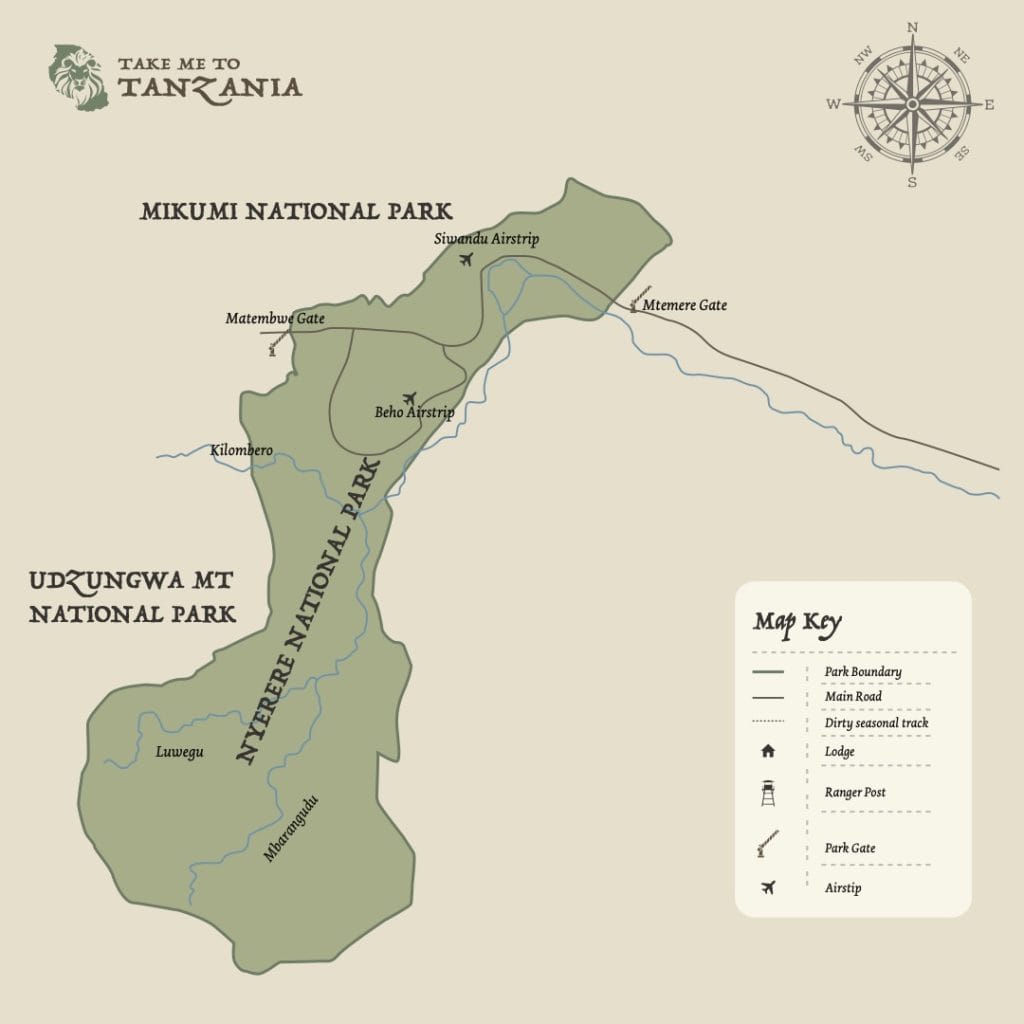
Nyerere National Park is well supplied with airstrips, and being relatively close to Dar es Salaam it fits well into many safari itineraries. This is especially since it is almost en route to Ruaha, Katavi and Mahale. And any one of these Parks can link by air to the northern circuits. Here are the main things to do:-
- Game Drives:- Explore the vast wilderness in an open safari vehicle, spotting elephants, lions, leopards, wild dogs, giraffes, hippos, and more. Best done in the early morning and late afternoon for prime wildlife viewing.
- Boat Safaris on the Rufiji River:- One of the park’s most unique experiences—cruise along the Rufiji River to see hippos, crocodiles, and a variety of bird species. Offers a different perspective of wildlife, including elephants and buffaloes drinking at the riverbanks.
- Walking Safaris:- Get closer to nature on a guided walking safari with an armed ranger. Learn about animal tracks, plants, and smaller wildlife while experiencing the park on foot.
- Bird Watching:- With over 440 bird species, the park is a paradise for bird lovers. Look out for fish eagles, kingfishers, bee-eaters, and spoonbills.
- Fishing Excursions:- Try your luck fishing in the Rufiji River, with chances to catch tiger fish and catfish. A great option for adventure lovers.
- Cultural Tours:- Visit a nearby village to experience local traditions, meet the people, and learn about their way of life.
- Fly Camping (Bush Camping):- Spend a night in a tented camp under the stars for an immersive safari experience. Perfect for adventure seekers wanting a true bush experience
Getting there
Air:- There are regular flights from Dar es Salaam and Arusha to a number of small airstrips supplying different camps and lodges.
Road:- There are 2 ways of getting to the park from Dar es Salaam. The shortest is about 240 km and goes via Kibiti to the Mtemere Gate. The longer but more interesting route (350 km) goes via Mikumi National Park, Morogoro, the Uluguru Mountains and Kisaki to the Matambwe Gate.
Train:- The Tazara railway traverses the National Park and one of the stops is at Kisaki, from where you will have to be picked up by a lodge vehicle. Other trains will stop at Matambwe near the Matambwe Gate.
OTHER DESTINATIONS
Serengeti National Park
Learn MorePrison Island
Learn MoreNgorongoro Conservation Area Authority
Learn MoreStone Town
Learn MoreMikumi National Park
Learn MoreChumbe Island Coral Park
Learn MoreMnemba Island
Learn MoreArusha City
Learn MoreDar es Salaam City
Learn MoreMount Longido
Learn More
